
The Impact of ICE Enforcement on Massachusetts Communities
How ICE enforcement operations have detrimentally affected our communities
ICE (Immigration and Customs Enforcement) enforcement operations under the second term of the Trump administration have detrimentally affected our communities, and the harm impacts everyone: citizens and lawful permanent residents as well as undocumented individuals across the United States.
For nearly two years, we have watched individuals being violently snatched away and abused by ICE agents at their workplace, schools, neighborhoods and traffic stops and over 50 people have died so far in ICE custody. Yet 70% of current detainees have no criminal convictions. Earlier this month, CNN reported that ICE plans to return to their previous goal of arresting 3,000 people per day. Demographically, Black and Brown immigrants have been targeted heavily by ICE enforcement actions and arrests so far. Many U.S. citizens and lawful permanent residents have been mistakenly stopped, racially profiled, and temporarily detained by ICE agents, including Native Americans. 170 U.S. citizens have been detained or reported missing during recent operations as well. As the Trump administration continues to increase enforcement measures, this Latino and Hispanic Heritage month, we look at how ICE’s terror has negatively impacted our communities across the country.
Latino/Hispanic communities have the highest detention & deportation rates nationwide
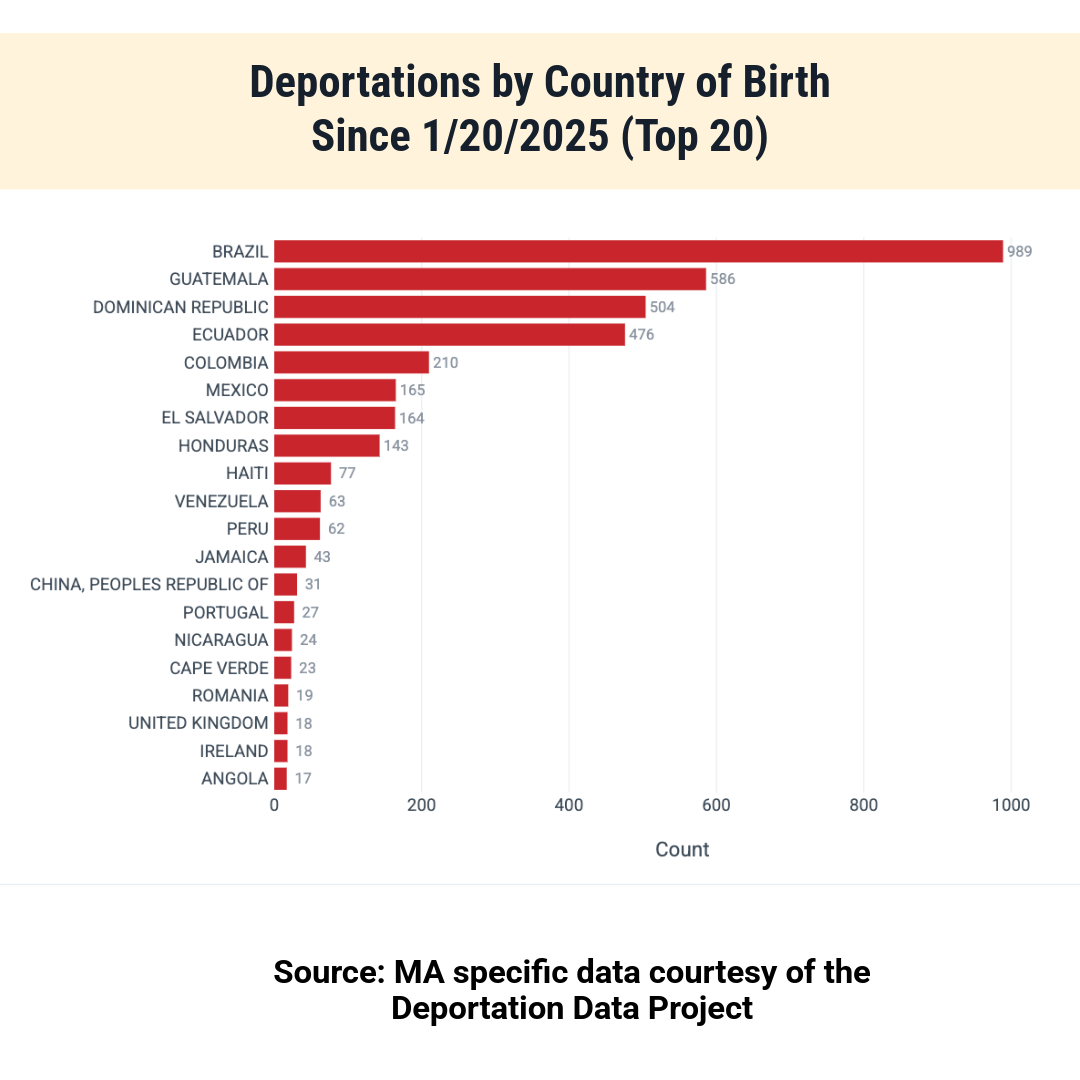
According to national data from the Trac Immigration Project, as of August 2026, immigrants from Mexico, Venezuela, Honduras, Guatemala and Colombia have the largest number ordered deportations. In Massachusetts as reported by the Deportation Data Project, immigrants from Brazil, Guatemala and Dominican Republic have the highest number of deportations.
Last year, the Pew Research Center conducted a national survey on Latinos’ experiences with immigration enforcement in the second Trump administration and discovered that “nearly half (47%) feel less safe in their local area because of the administration’s deportation actions” and some Latinos “have changed their daily routines in recent months because they think they will be asked to prove their status in the country.”
How ICE enforcement impacts families & communities
Increased ICE enforcement has created widespread fear amongst immigrant and non-immigrant communities nationwide. The physical & psychological impact is further straining our healthcare system, the economy and thus disrupting the livelihoods of our immigrant neighbors.
- Family Separation: Since the start of the Trump administration in January of 2025, over 400,000 immigrants have been detained. According to the Brookings Institute, they estimate that over 200,000 children have been separated from their parents due to ICE detention and 71% of these children are U.S. citizens and over 30% of those children are younger than six years old. Many of these children end up in foster care if they do not have an extended family member or guardian to care for them.
- Mental Health Challenges: Immigrants are facing a pervasive mental health toll driven by the stressors and triggers of ICE detention, deportation and family separation. The fear of forced removal, detention, or risk of losing a parent or caregiver has elevated chronic fear, hyper-villeance, anxiety, depression and in some recent local stories, suicide. Mistreatment in ICE detention has further increased suicides. According to a reporting from AP News, “suicides account for nearly a fifth of the 51 deaths in ICE custody since January 2025. The majority of those deaths were from natural causes and experts say many of them would have been preventable with timely medical care.”
- School Attendance and Performance: Schools are increasingly becoming sites of fear and trauma as ICE immigration raids continue to terrorize communities. Drastic changes and stressors in a student’s household can impact their performance in school and cause them not to attend school due to fears of them or their family members being taken by ICE during school drop-offs, along bus routes, or around campus perimeters.
- Economic Instability: The removal of primary breadwinners in an immigrant household leads to severe financial hardship and can further heighten other barriers such as housing instability and food insecurity. Furthermore, ICE raids have negatively impacted the labor force of several key industries, including construction, food service, and healthcare. As reported by Boston Indicators, in Massachusetts, “while immigrants make up about 20 percent of the Commonwealth’s population, they account for 24 percent of the labor force.”
- Disrupting Essential Services and Daily Routines: Immigrant families are skipping essential medical & preventive services due to fears that personal data could be shared with ICE agents or that ICE might appear at clinics. Moreover, many are increasingly avoiding public spaces and routine activities like grocery shopping, attending religious services, or important immigration court appointments due to the fear of encountering ICE.
- Public Safety: The fear of immigration exposure has also caused a rise in unreported crimes from both victims of crimes and community members who witness crimes, and a lack of immigrants testifying in court because of the generalized anxiety that contacting law enforcement could trigger immigration action.
What can the community do to support immigrants?
- Share Resources:
-
-
- Share ‘Know Your Rights’ (KYR) resources so you or your neighbors can be prepared for potential ICE interaction.These are available in many languages. KYR information includes legal resources, family preparedness tools, upcoming trainings, bystander tips and more.
-
- Legal Assistance Massachusetts:
- Contribute to a local ICE watch and/or legal services organization
-
-
- The statewide LUCE Defense Hotline is recruiting both hotline operators (especially individuals with relevant language skills) and neighborhood ICE watch volunteers.
- The Boston Immigrant Justice Accompaniment Network (BIJAN) provides accompaniment and support to those interacting with immigration systems including those in detention.
- PAIR provides free immigration services to indigent asylum seekers and detained immigrants, assuring fairness and access to justice.
-
- Support our MIRA Coalition Members: Our 160+ member organizations are actively supporting our immigrant communities across New England. Learn more about their work and please get involved.
- Contribute to mutual aid efforts
-
- The Boston Immigrant Justice Accompaniment Network (BIJAN): Operates the Beyond Bond & Legal Defense Fund which raises money for immigration bonds to free people in ICE prisons in Massachusetts and Rhode Island or elsewhere, but are coming to live in MA upon release.
- Operation Milkweed: provides mutual aid and direct support for Massachusetts families impacted by ICE enforcement since 2025.
- Metrowest Worker Center – Casa: Focuses on food security, worker leadership, and direct aid for families.
- Massachusetts Migrant Families Relief Fund: Distributes grants to local organizations providing emergency aid like housing and, clothing.
- Community Legal Aid: Offers free legal representation to low-income non-citizens in Central and Western MA.
- Vote: Your voice and vote matters! Find resources around early voting, understanding your ballot, and election safety here: 2026 Resources for MA Voters
IMPORTANT DATES:
Voter Registration deadline: October 24
Vote by Mail Application Deadline: 5 p.m., October 27
IMPORTANT: if you plan to mail your ballot, you should apply 2-3 weeks before the election date.
You can also drop off your ballot in person during the early voting period.
Early Voting Period: October 17-30
State Election Day: November 3
Election Day Polling Hours: 7 a.m. – 8 p.m.
Sources:
- https://tracreports.org/immigration/quickfacts/detention.html
- https://goldman.house.gov/media/press-releases/goldman-warren-padilla-kelly-and-correa-demand-investigations-ices-detention
- https://tracreports.org/immigration/quickfacts/eoir.html
- https://miracoalition.org/resources/massachusetts-deportation-data-dashboard/
- https://www.pewresearch.org/race-and-ethnicity/2025/11/24/latinos-experiences-with-immigration-enforcement-in-the-second-trump-administration/
- https://www.brookings.edu/articles/the-administration-has-detained-400000-immigrants-what-do-we-know-about-their-children/
- https://www.wgbh.org/news/local/2026-08-07/silent-detention-mental-health-impact-of-ice-arrests-on-families-reaches-crisis-point
- https://apnews.com/article/ice-suicide-deaths-detention-custody-d902169055292dfd27f5079e609e86ad
- https://edtrust.org/blog/ice-raids-upending-schools-communities/
- https://www.bostonindicators.org/imm_workforce