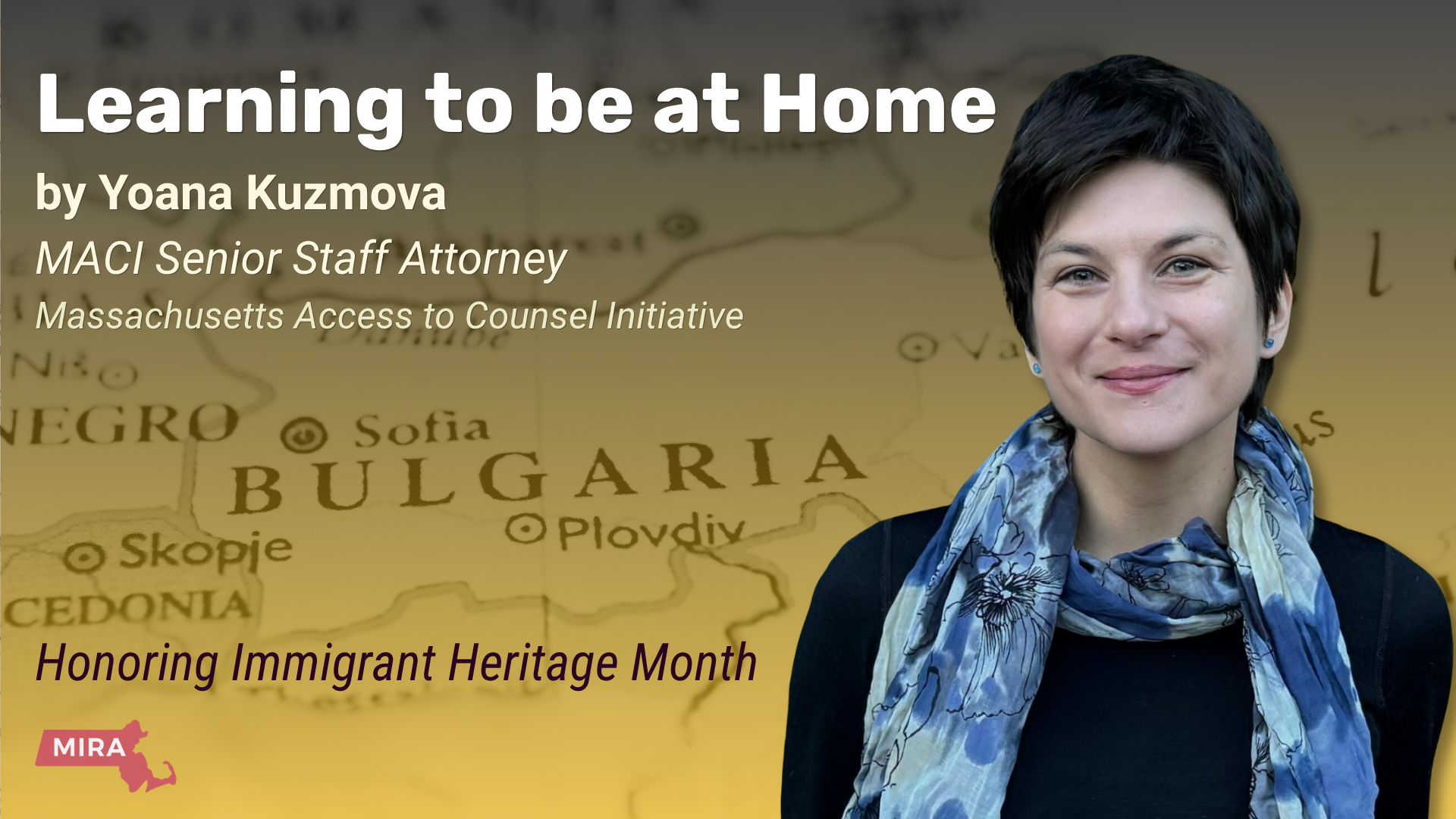
Learning to be at Home by Yoana Kuzmova, MACI Senior Staff Attorney
In 2026, immigrant heritage month is a welcome reminder of the unquestionable reality of an immigrant heritage for the vast majority of this country’s citizens. Recognitions like it are part of what makes Massachusetts home to me. Being an immigrant, along with migration’s banal calculus of survival and striving for upward social mobility, have marked my whole life. Strictly speaking, I am a naturalized U.S. citizen. My journey to this status began 23 years ago and passed through the standard hurdles placed by our immigration system, nominally meant to protect the U.S. labor market from too many skilled migrants from overseas. Over time, I learned that these hurdles are also considered a backstop to “brain drain” – the phenomenon of graduates of foreign universities undercutting wages when they arrive in the U.S., having benefited from free or subsidized higher education, and willing to settle for lower salaries than local workers.
For longer than I’d like to admit, I felt rather put upon by what I perceived were the undue burdens placed on U.S. college grads from abroad looking to work in their fields of study. Gradually, I realized I had had it easy. Being a white woman arriving as a fluent speaker of English from the former Soviet bloc, I was among those whose immigration raised few flags. I was born in Plovdiv, Bulgaria’s second biggest city, and I grew up in the rural Bulgarian south. My parents and brother remain in Bulgaria, but extended family has scattered across Europe. My childhood’s first migration was the product of job opportunities drying up for my accountant mother, as a result of her unearned status as the daughter of a small-town Communist party figure. Post-communist Bulgaria’s transition to a market economy often entailed the blacklisting of people in my mom’s position. In the capital city, Sofia, she didn’t have to fear guilt by association. As the older child, at 11, I came along eagerly – I have always favored travel, change, and public transit – all in short supply in the rural area we came from.
In Sofia, without any grandparents nearby, I would go from school to my mom’s office and stay there until her workday ended. It so happened that our move to Sofia coincided with the hyperinflation shock of 1997, throwing off all aspects of Bulgaria’s fledgling market economy, the business of accountants included. We’d regularly return to our one-bedroom rental well past midnight. Hyperinflation meant that bread and other necessities were purchased with rationed coupons. The city was barricaded, schools closed. Then, university students did their part and stormed Bulgaria’s parliament.
After the first cataclysmic year of my micro-migration to Sofia, life took a turn for the better: The Bulgarian currency was devalued, prices in shops lost 3 zeros overnight. The rationed bread disappeared along with the barricades. Still, everyone who spoke a foreign language or had a skillset desirable in the “West” was planning an exit, spooked by the evaporation of their savings. Opportunities for further out-migration must have been what my mom had in mind for me, too, when she encouraged me to sit entrance exams for the “elite” high schools – a group of public schools that taught their subjects in foreign languages and emphasized STEM classes. I was admitted to the unimaginatively titled “First English Language School”, a once prestigious institution, which in 1998 shared its dilapidated building with an elementary school, requiring us to shuffle out of our classrooms quickly so that the 1st graders could use them in the afternoon (or next morning, shifts alternated).
At some point, I registered that over half of the graduating classes before me had gone to college abroad, so I took measures to study for the TOEFL and SATs after school and during breaks, borrowing books from the British Council library. I also noticed that Bulgarian universities were not on the winning side of the country’s transition to a market economy. “Brain drain” was an often broadcast phrase I learned before I could understand its implications, but I understood enough to take action. I applied to many universities in Europe and a few in the United States, which I felt would not be a wise destination given the distance from family and my pre-political opposition to war, especially war waged on abstract concepts.
Ironically, only colleges in the US made offers that my mom and I could actually afford. I did not learn the phrase “moral injury”until later, but ambivalence I knew about. Armed with two suitcases full of it, I arrived at my college campus in August 2003.
I studied neuroscience, and prepared to become a brain scientist, because my initial preferences (urban studies, Hispanic studies, and a major called “science technology and society”) I deemed too impractical for a skilled worker visa. It took three years of working in a lab after college to finally, and impractically, realize that what I most cared about was to help usher in a world where newcomers are welcome, or at the very least (an immigrant always has a backup plan!) – a world where the only ones called “aliens” arrive in spaceships.
Today, I am honored by the opportunity to ease the passages of others whose journeys to permanence and safety in the US have not been as privileged as mine. To me, immigrant heritage month is at once the most universal of celebrations for all of us in the United States, and a neat coincidence in time with two other recognitions of human liberty that I cherish – LGBTQI+ Pride month and Juneteenth.
My definition of an immigrant is someone who has learned to be at home in at least two different places, someone who carries a palpable awareness of more than one rhythm and order of life. What I hope my US-born son retains as his immigrant heritage, along with Bulgarian language and culture, is an applied belief that “home” can only be felt or made where one is accepted and allowed to build a better life not just for oneself, but for all of society; and, ultimately, that everyone deserves to be at home where they live.
Yoana Kuzmova joined MIRA in 2025 as a Senior Staff Attorney at the recently launched Massachusetts Access to Counsel Initiative (MACI).