
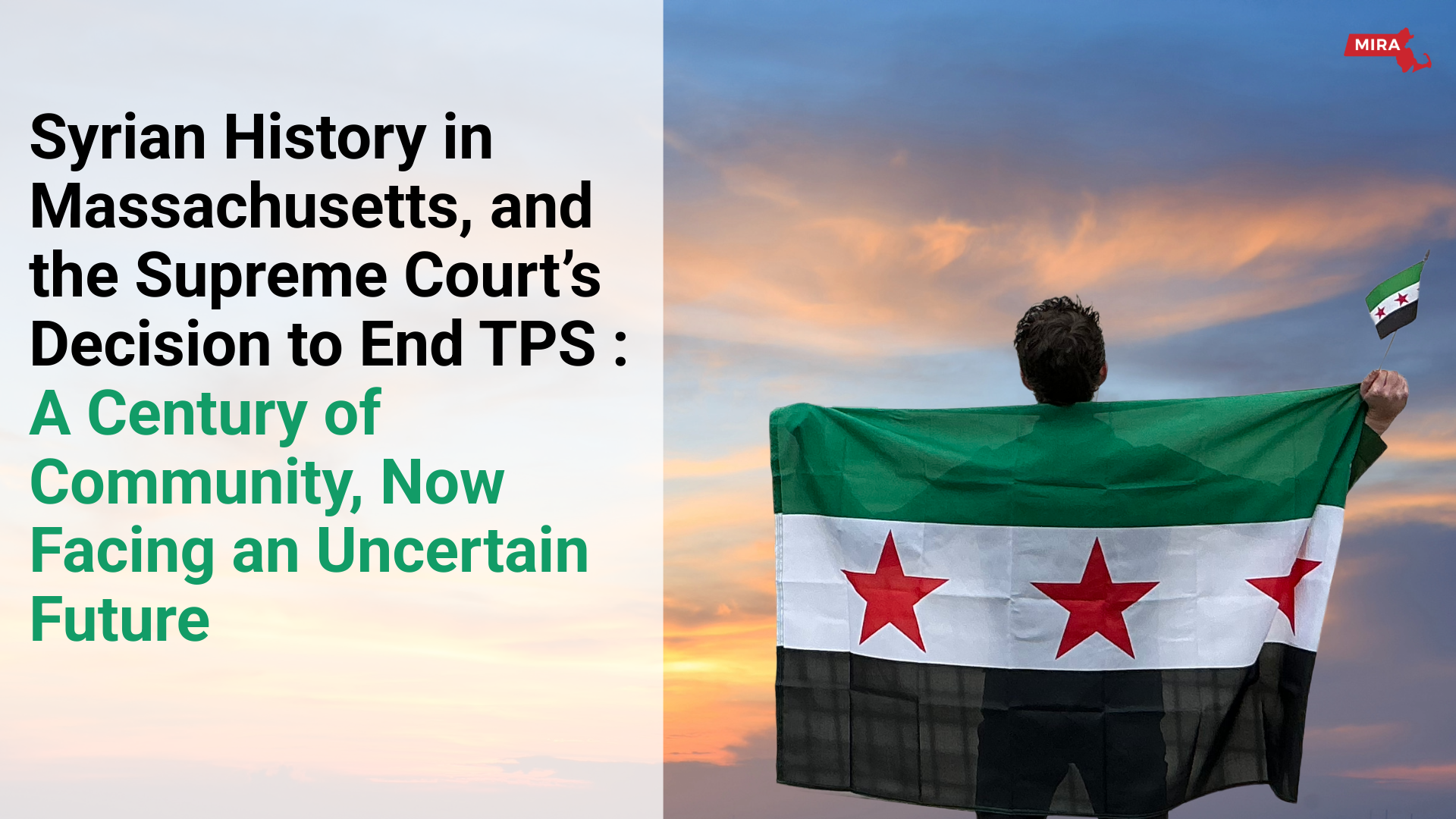
In 1917, in the middle of a humanitarian catastrophe overseas, a group of 27 immigrant women in Boston’s South End came together to help their neighbors.¹ They called themselves the Society for the Relief of Syria and Lebanon. War, famine, and disease had devastated their homeland, and they had no intention of watching from a distance. The organization they built, later renamed the Lebanese Syrian Ladies’ Aid Society, is still active today, still raising money for families in need, more than a century after its founding.²
By the late 1930s, as many as 40,000 Syrians and Lebanese immigrants called Massachusetts home, 15,000 of them in Boston alone.³ They built churches, ran newspapers, sent their sons to fight in two world wars, and planted roots so deep that “Little Syria” became a defining part of the city’s identity long before most of us were born.
That history matters right now, because on June 25, 2026, the U.S. Supreme Court ruled that the federal government may proceed with ending Temporary Protected Status (TPS) for Syrian nationals.⁴ TPS holders are expected to lose their status and work authorization by late July, likely around July 27.⁵
What the ruling means
TPS was created so people could not be sent back to countries where it is genuinely unsafe to return. Syria has held that designation since 2012, when the world watched the Assad regime turn its own military against civilians.⁶ Over 6 million refugees have fled Syria since the start of the conflict, making it one of the largest displacement crises globally. Today, more than 6,100 Syrians nationally hold TPS, and another 800 have applications still pending.⁷ Many have lived, worked, and raised families in the U.S. for over a decade.
The Court did not rule that Syria is safe. It ruled that courts have no authority to review how the government makes or unmakes these decisions at all, even when the required legal steps, like consulting other federal agencies about conditions on the ground, may not have been followed.⁸ As Justice Kagan wrote in dissent, the practical result is that “hundreds of thousands of…Syrians living in this country will lose their legal status and work authorization,” many with nowhere safe to return to.⁹
Among the plaintiffs is a woman known in court filings as Dahlia Doe, a research director who has lived in the U.S. since 2015 and is the sole caregiver for her elderly father, a U.S. permanent resident living with Parkinson’s disease.¹⁰ Losing her status would not just upend her own life. It would leave her father without the person caring for him, and send her back to a country where, as a religious minority, she fears targeted violence.¹⁰
Why this matters here
Syrian TPS holders are not an abstraction. They are healthcare workers, teachers, students, and small business owners, many of them in communities across Massachusetts that trace back generations. Syrian TPS holders contribute $100 million to our economy every year and they are parents, essential workers, and community leaders with U.S. citizen family members who depend on them. When someone loses work authorization, it is not only their paycheck that disappears. It is the shift not covered at a hospital, the shuttered main street business, the family unable to make rent. Entire communities absorb that loss.
We are inheritors of a place that has always found ways to show up for people fleeing danger, whether that was 27 women organizing in 1917 or the advocates, attorneys, and neighbors doing that work today. That history did not happen because it was easy. It happened because people decided their community was worth protecting.
What you can do
Support organizations providing legal screenings and Know Your Rights information to Syrian TPS holders. Contact your members of Congress and ask them to support a permanent legislative solution for TPS holders, since only Congress can provide the lasting stability that executive action cannot. If you have friends and family in other, less immigrant-welcoming states, ask them to do the same.
And if you know someone with TPS, make sure they know that qualified legal help exists, and that they do not have to face this decision alone. They can call MIRA’s Immigration Helpline at (508) 293-1871, or schedule a consultation with a qualified immigration attorney.
The Syria TPS litigation team (Muslim Advocates, International Refugee Assistance Project, and Van Der Hout) are also partnering with Immigrant Justice Corp (IJC) to host a virtual immigration screening clinic for Syrian TPS holders. The purpose of the project is to help Syrian TPS holders apply for alternative immigration status to help ensure there is no break in lawful presence in the event that TPS is terminated. Schedule your appointment here. For any questions please contact us at info@immigrantsactnow.org
A century of history did not happen because it was easy. It happened because people showed up for their neighbors, and that is what this moment asks of us again.
Resources
Contact the National TPS Alliance to connect with fellow beneficiaries, join local advocacy groups, and find community support.
Find legal resources For Syrian TPS Holders ➡️ https://bit.ly/tps-legal-resources
Schedule a virtual immigration screening clinic appointment with Immigrant Justice Corp (IJC) here.
The Mayor’s Office for Immigrant Advancement offers free one-time immigration consultations on the first and third Wednesday of every month from 12:00 – 3:00 p.m. Schedule your appointment here.
Sources
- Leventhal Map & Education Center at the Boston Public Library, “Boston’s Little Syria,”
- Lebanese-Syrian Ladies’ Aid Society of Boston
- “Boston’s Little Syria,” Al Jumhuriya, citing 1930s Boston Globe and Boston Daily Globe reporting on Syrian population figures in Massachusetts.
- Mullin v. Doe, 609 U.S. ___ (2026), decided June 25, 2026 (consolidated with Trump v. Miot, No. 25-1084).
- International Refugee Assistance Project (IRAP), “Community Updates About the Supreme Court’s Decision in the Ongoing Lawsuit Challenging the Termination of TPS for Syria,” June 29, 2026, noting the Court’s decision typically takes effect 32 days after issuance, placing termination around July 27, 2026.
- Mullin v. Doe, slip op. at 7-8, describing Syria’s initial 2012 TPS designation (77 Fed. Reg. 19027) under the Assad regime.
- IRAP, Muslim Advocates, and ACLU of Northern California, “Haiti & Syria TPS Case at Supreme Court – What You Need to Know” factsheet
- Mullin v. Doe, slip op. at 12-18 (holding that 8 U.S.C. §1254a(b)(5)(A) bars judicial review of non-constitutional claims, including procedural claims about agency consultation).
- Mullin v. Doe, Kagan, J., dissenting, slip op. at 12-13.
- IRAP, Muslim Advocates, and Van Der Hout LLP, Dahlia Doe v. Noem case materials, describing plaintiff Dahlia Doe’s residency since 2015, caregiving role, and religious-minority status as a Syrian Christian.