
How Trump’s immigration policies are impacting the mental health of our immigrant community members
#NationalSuicidePreventionMonth
Written by MIRA’s Communications Specialist, Farah Jeune

Last Monday, August 31st Pierre Damas Bel, a 20-year old student from Haiti, committed suicide by walking into traffic on an interstate highway in Springfield, Ohio. Pierre previously had Temporary Protected Status (TPS) but on July 27, 2026 he became one of the thousands of people whose legal status was terminated by the Trump administration.
Pierre, who was studying neuroscience at Wright State University, had been forced to wear a GPS ankle monitor by Immigration and Customs Enforcement (ICE) after his legal status was revoked. As a result, he experienced immense shame and bullying which ultimately impacted his fate.
It’s clear to see that not only was Pierre’s fate preventable, it was also a direct outcome of the racist and harsh immigration agenda the current administration is pursuing.
Pierre was very much living his “American dream.” Legally documented to be in the U.S., he focused on getting a great education, was accepted into college and was an active and proud ROTC (Reserve Officers’ Training Corps) student. ROTC is a college-based program that trains students to become commissioned officers in the United States armed forces. He did everything the “right way.”
Outside of his education and patriotism, Pierre also loved playing soccer. Like many young men his age, the sport gave him joy but also community, brotherhood and pride. Being a part of these various small communities enriched his life, especially as an immigrant in a new environment. When Temporary Protected Status (TPS) for Haiti was revoked in late July, it not only stripped away his legal status, it robbed him of his dignity and the community support he relied on. As Pierre’s father Pierres Ronal Bel shared in a statement with Dayton Daily News, “After my son was outfitted with an ankle monitor, he felt like he was treated like an animal…He took two trips to Cincinnati and Westerville to plead the officers to remove the bracelet since he’s a soccer player and he felt embarrassed and humiliated.”[1]
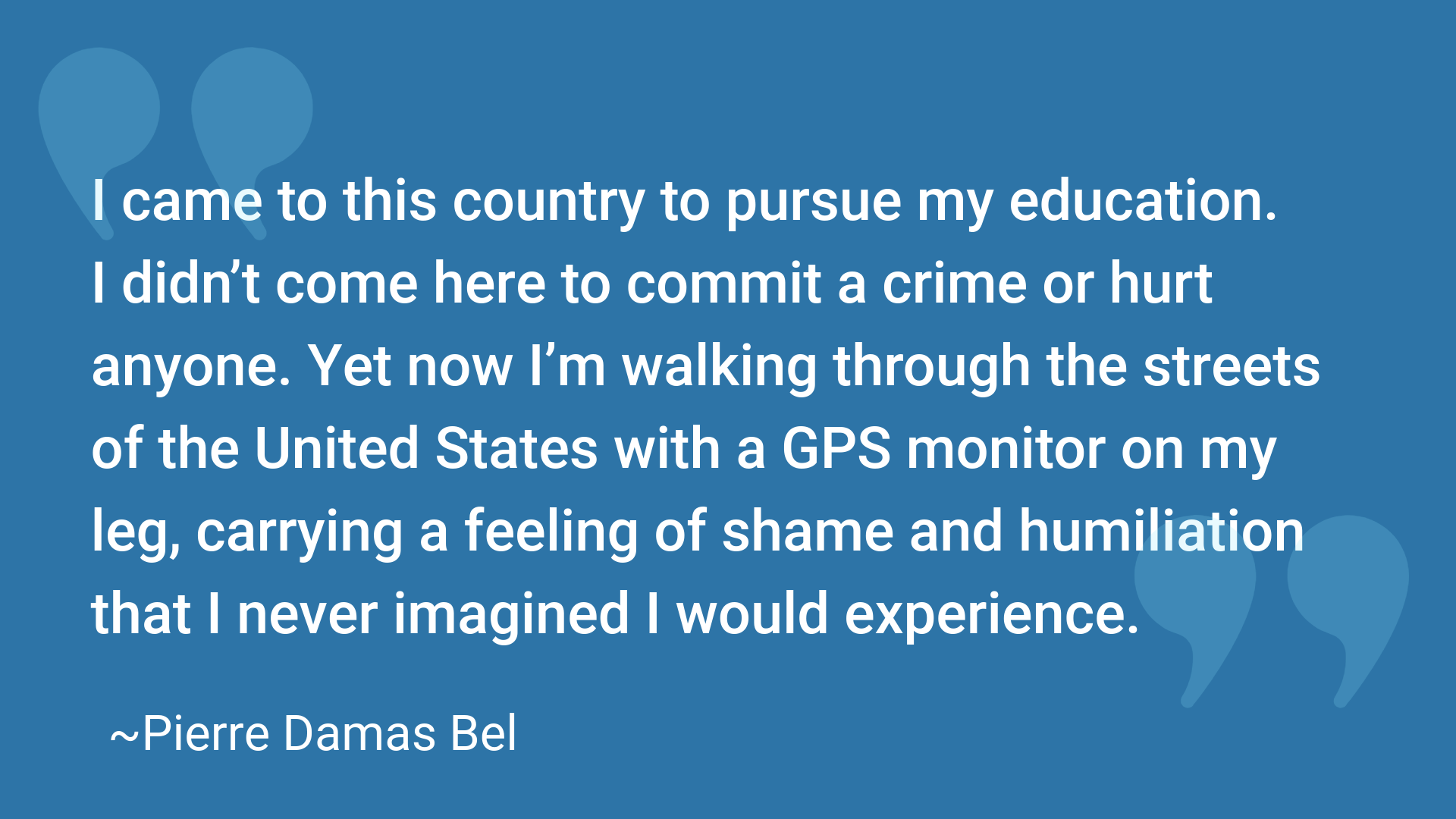
Pierre was unable to play soccer once he was forced to wear the ankle monitor. He was bullied by his peers and soon felt ostracized from the very spaces where he once found joy and safety in. One can only imagine how deeply traumatizing that must feel for a person who has done nothing wrong, and the damage it could bring upon one’s mental and spiritual health. According to The Anxiety and Depression Association of America (ADAA), “men account for nearly 80% of suicide deaths in the United States” and have a hard time getting the mental health support they need “often because of stigma, cultural expectations, or the belief that asking for help is a sign of weakness.”[2] For young Black men between 15-24 years old, suicide is the third leading cause of death.[3] Although mental health has become a more discussed pop culture topic, it is still very much a taboo subject in many cultures, including the Haitian community.
As a Haitian American, Pierre’s death has troubled my spirit. To read and watch videos of his family grieving, knowing that the only reason Pierre is not physically here is because he was robbed of his dignity, freedom, and self-worth by our current immigration policies, is haunting to sit with. The United States has a long history of Anti-Haitianism through harsh government policies, racist and negative media stereotypes, and false political rumors.[4] In 2021, we saw videos of Border Patrol agents in Del Rio, Texas chasing down Haitians on horseback with whips. In 2024, JD Vance spread false rumors that Haitians were eating people’s pets in Springfield, Ohio which then led to over 30 bomb threats and targeted harassment against Haitians, forcing the temporary closure of local schools, hospitals, and city government buildings.[5] In 2026, we watch more videos of ankle monitors being attached to Haitians, the emotional weight of it so heavy that it had Haitians falling to their knees with despair. These events are not only examples of anti-Blackness but recycled torture strategies that were once used on enslaved people.
Anxiety and Fear are stifling our immigrant communities nationwide and we need to take action!
Pierre’s story is part of a much broader reality that immigrants are experiencing about the uncertainty of their futures under this current administration. Over 1 million people, from roughly a dozen countries, have lost or are facing the termination of their Temporary Protected Status (TPS) this year.[6] As of July 2026, more than 65,000 people are in ICE detention, 70% of whom have no criminal convictions.[7] DACA recipients are continuing to navigate chronic uncertainty, as the program lacks a pathway to permanent citizenship and faces constant legal threats.[8] Moreover, the impact of ICE detention and family separation on the mental health of immigrant families is devastating. “Barriers to getting help are structural and cultural, including lack of access to health insurance that covers behavioral health; the cost of appointments; a shortage of clinicians and those that understand the layers of trauma experienced by immigrants; personal hesitation; and cultural stigma.”[9]
The Trump administration’s immigration and enforcement policies are poisoning our country. Our neighbors are living with so much fear. They are afraid to leave their houses, they are unable to work to provide for their families and are paranoid that they are constantly being monitored. All of this impacts one’s overall wellness and this lack of stability quickly spreads amongst one’s community. The amount of pain, anxiety and various forms of trauma this administration has instilled into our immigrant communities nationwide is immeasurable; this trauma will carry on for generations.
We need to do more than just tell our immigrants to continue to be resilient, we need to take action and support policies that will provide them with pathways to citizenship.
🚨Tell your legislators to pass S.4814 and the DREAM and Promise Act!
- Pass S.4814 – this bill would extend TPS for Haiti until early 2029, and assert Congress’s power to act in the face of injustice. Massachusetts Senators Markey and Warren already support this bill, but can be thanked for their support. If you have colleagues, friends and family in other states, please ask them to send a letter to their Senators today!
- Support the DREAM and Promise Act: The American Dream and Promise Act is a proposed federal bill that would provide a pathway to lawful permanent residence and eventual citizenship for eligible Dreamers, Temporary Protected Status (TPS) holders, and Deferred Enforced Departure (DED) beneficiaries. Learn more about the Dream Act here.
Pierre should be alive today. Black boys and Black immigrants deserve to grow old. Support Pierre’s family. Honor Pierre’s memory by taking action to protect and support our immigrant community members AND practice kindness. We never know how much emotional weight others are carrying.
September marks Suicide Prevention Awareness Month
Here are some mental health resources for community members who need support.
✨Immediate Help and Crisis Resources
Call or Text 988: Reach the 988 Suicide & Crisis Lifeline for free, confidential support 24 hours a day, 7 days a week.
✨ RESOURCES FOR MEN
- Anxiety and Depression Association of America (ADAA) Resources can be found here
- The ManKind Project – They provide free, confidential, online Men’s Groups throughout the country. Find out more here
- BEAM: Black Emotional and Mental Health Collective – create spaces and tools for collective healing and crisis response. Tools and Resources available here.
- Black Men Heal Kings Corner is a virtual weekly meetup group that discusses different topics applicable to men’s mental health issues or struggles. Learn more here.
- American Foundation for Sucide Prevention – Mental Health Resources for Hispanic and Latino communities here.
- Asian Mental Health Project – Asian Mental Health Project offers Stay in, Check-in every Wednesday as well as multiple other free, facilitator-led wellness groups for community healing hosted on Zoom. Find resources here
- Mental Health America – resources for communities of Arab descent here
✨RESOURCES FOR IMMIGRANTS
- The Boston Mayor’s Office – resources for city of Boston residents to support immigrant constituents here
- Immigrants Rising – Mental Health Resources for Undocumented People here
- Lakou Tanama – a space where Haitian community members can come together to talk, listen, and support one another in a safe environment. For more information, visit their website here.
- Haitian Mental Health Network (HMH) – a volunteer-led, non-profit organization that is dedicated to promoting greater awareness and understanding of mental illness and mental wellness in the Haitian community, facilitating community conversations on mental health, and celebrating culturally and spiritually-based practices that foster community well-being. Get connected with them here.
- MIRA Coalition – Legal and Mental Health Resources for Haitian and Syrian Communities here
- MIRA Coalition – MIRA’s Youth Toolkit includezs Know Your Rights resources, mental health resources, immigration terminology, information on how to get involved as an immigrant advocate, and financial aid information for immigrant students. Find it here.
✨RESOURCES FOR YOUTH
- Heads Up Boston – The Boston Mayor Office has put together a list of helplines, websites, and programs that can assist teens. Find resources for Youth here.
- National Alliance on Mental Illness (NAMI) – Find resources for kids and teens here.
Footnotes
[1] https://www.daytondailynews.com/local/they-treated-my-son-like-an-animal-father-speaks-out-after-haitian-students-suicide/article_04279ad9-00bd-5f52-b19c-ab9895891b5e.html
[2] https://adaa.org/find-help/by-demographics/mens-mental-health
[3] https://www.nami.org/blog/black-men-and-mental-health-practical-solutions/
[4]https://www.hks.harvard.edu/centers/carr-ryan/our-work/carr-ryan-commentary/haitians-border-nativist-state-and-anti-blackness
[5] https://www.nbcboston.com/video/local/springfield-ohio-pet-eating-claims-latest-reaction-analysis/3491753/
[6] https://www.americanimmigrationcouncil.org/fact-sheet/temporary-protected-status-tps-overview/
[7] https://tracreports.org/immigration/quickfacts/
[8] https://www.nilc.org/work/daca/
[9] https://www.wgbh.org/news/local/2026-08-07/silent-detention-mental-health-impact-of-ice-arrests-on-families-reaches-crisis-point