Call To Action: Proposed Public Charge Rule
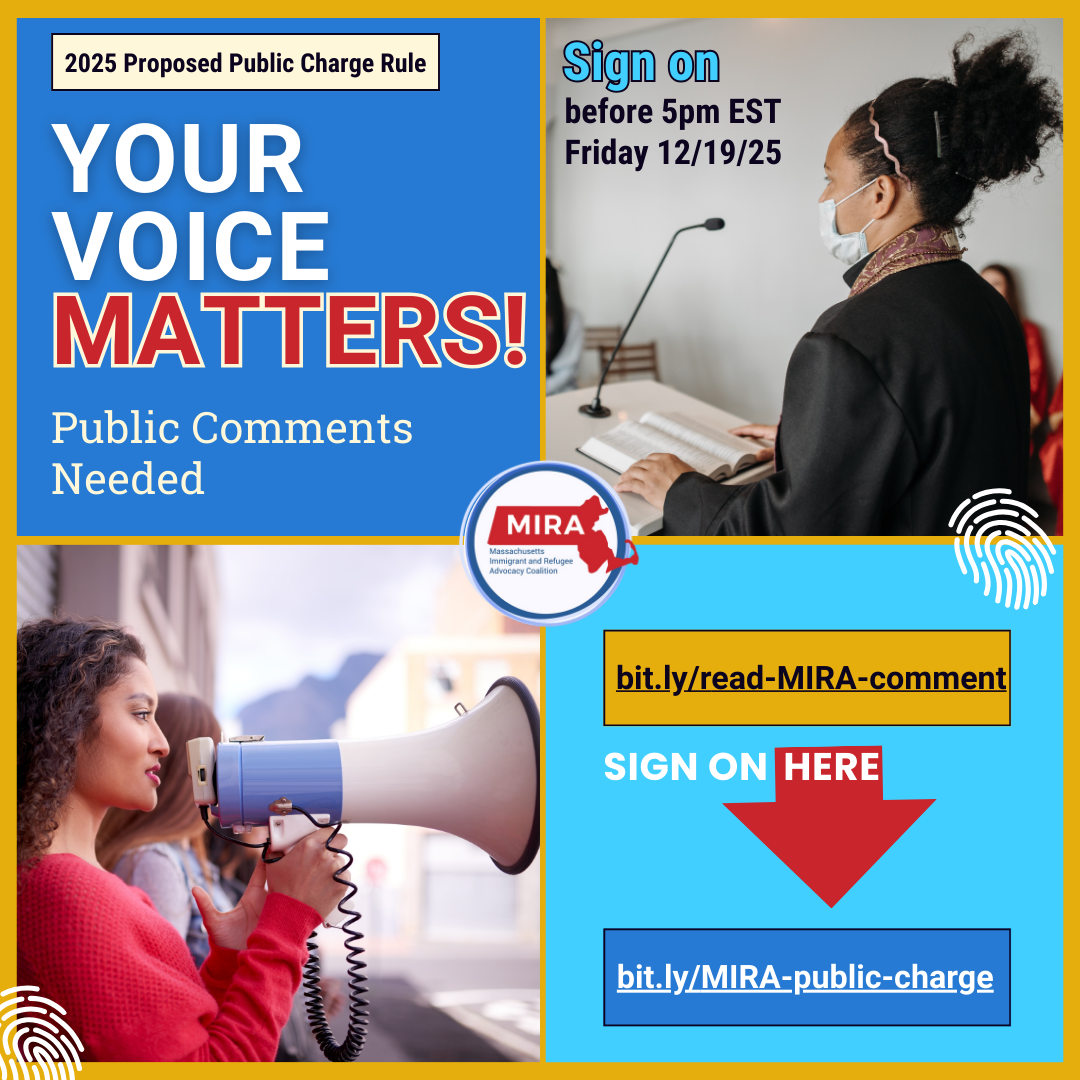
We have entered the home stretch of our race to collect comments in opposition to the administration’s proposed public charge rule. As many of you are already aware, the administration is trying to place additional obstacles along the pathway to a green card by eliminating existing regulations around public charge without offering a replacement. This plan is a recipe for chaos and confusion and will hurt all of our communities, immigrant and non-immigrant alike. MIRA has drafted a comment in response to this proposal, and we invite other organizations to sign on. You can read the comment here and use this form to sign-on. The deadline for sign-ons is Friday December 19th at 5pm EST.
Other sign-on opportunities exist to voice your opposition, and organizations are free to sign-on to multiple comments.
The Protecting Immigrant Families coalition is inviting signatures on their letter which addresses the general impact on immigrant families and health. You can find PIF’s comment here and the sign-on form is here.
Asian Americans Advancing Justice invites organizations with a sizable AAPI constituency to sign-on to their comment, which you can find here. The sign-on form is here.
The Children’s Thrive Action Network is also looking for organizations to join their comment, which focuses on the serious harm that this proposal would do to children. You can find their comment here, and the sign-on form is here.
Policy Updates
- News media has reported what advocates have long suspected, that the Transportation Security Administration (TSA) is sharing airline passenger lists with ICE in data dumps that take place multiple times a week. ICE is running this information against their own database, searching for individuals to detain. This places anyone with uncertain, expiring, or expired immigration status at risk for detention when trying to board a flight. This risk will be particularly high for those with old deportation orders and anyone who had their TPS or parole status revoked by the administration. With so many wishing to travel to visit family or friends for the holidays, we strongly encourage people to consult with a qualified immigration attorney if they are unsure of their status or their risk of traveling.
- Last week, the Trump Administration announced the termination of all Family Reunification Parole programs. This program, initiated by the Obama Administration and expanded under Biden, allowed beneficiaries of family-based immigration visas to enter the work and obtain work authorization for up to 3 years while they wait for an immigration visa to become available, a process that can frequently take many years or even decades. The program was available to family members from Colombia, Cuba, Ecuador, El Salvador, Guatemala, Haiti, and Honduras, and individuals waiting for visas had to be invited by the US government to apply for parole. Beneficiaries of the program will lose their parole and work authorization on January 14, 2026 unless they either had an application for adjustment of status pending as of December 15, 2025 or if the Secretary of Homeland Security determines that an individual’s parole should not be revoked. As with so many issues, MIRA recommends the people worried about the impact of their announcement on their status consult with an experienced immigration attorney as soon as possible.
- On Friday, the administration also announced the termination of TPS for Ethiopia. TPS for Ethiopians had been slated to expire on December 12, but federal law requires the automatic extension of status for 60 days from the date the government officially announces its intention, meaning that Ethiopians currently on TPS have their status and work authorization extended until February 13, 2026. Once again, MIRA strongly encourages those in danger of losing their status to consult with a qualified immigration attorney to determine what options for them might be available.
- Earlier this week, the administration announced a new travel ban, dramatically expanding the ban that had previously been announced in June. In addition to expanding the list of countries impacted, it also removes exceptions from the old policy. Immediate relatives of US citizens from these countries are no longer eligible to obtain a visa (although existing visas will not be rescinded). The Trump Administration will also stop granting Special Immigrant Visas to Afghan nationals, which had previously been available to those who assisted US forces during our nearly 20-year war in the country. You can find a factsheet on the latest travel ban here, and a comparison of the new and old travel bans here.
Under the new travel ban, individuals from the following countries are subject to a full ban on travel to the United States effective immediately:
- Burkina Faso
- Mali
- Niger
- South Sudan
- Syria
- Individuals holding Palestinian-Authority issued documents
- Laos (previously subject to partial restrictions)
- Sierra Leone (previously subject to partial restrictions)
Individuals from the following countries are subject to a partial travel ban, making them ineligible for the most common forms of non-immigrant visas effective January 1, 2026:
- Turkmenistan
- Angola
- Antigua and Barbuda
- Benin
- Cote d’Ivoire
- Dominica
- Gabon
- Malawi
- Mauritania
- Nigeria
- Senegal
- Tanzania
- Tonga
- Zambia
- Zimbabwe