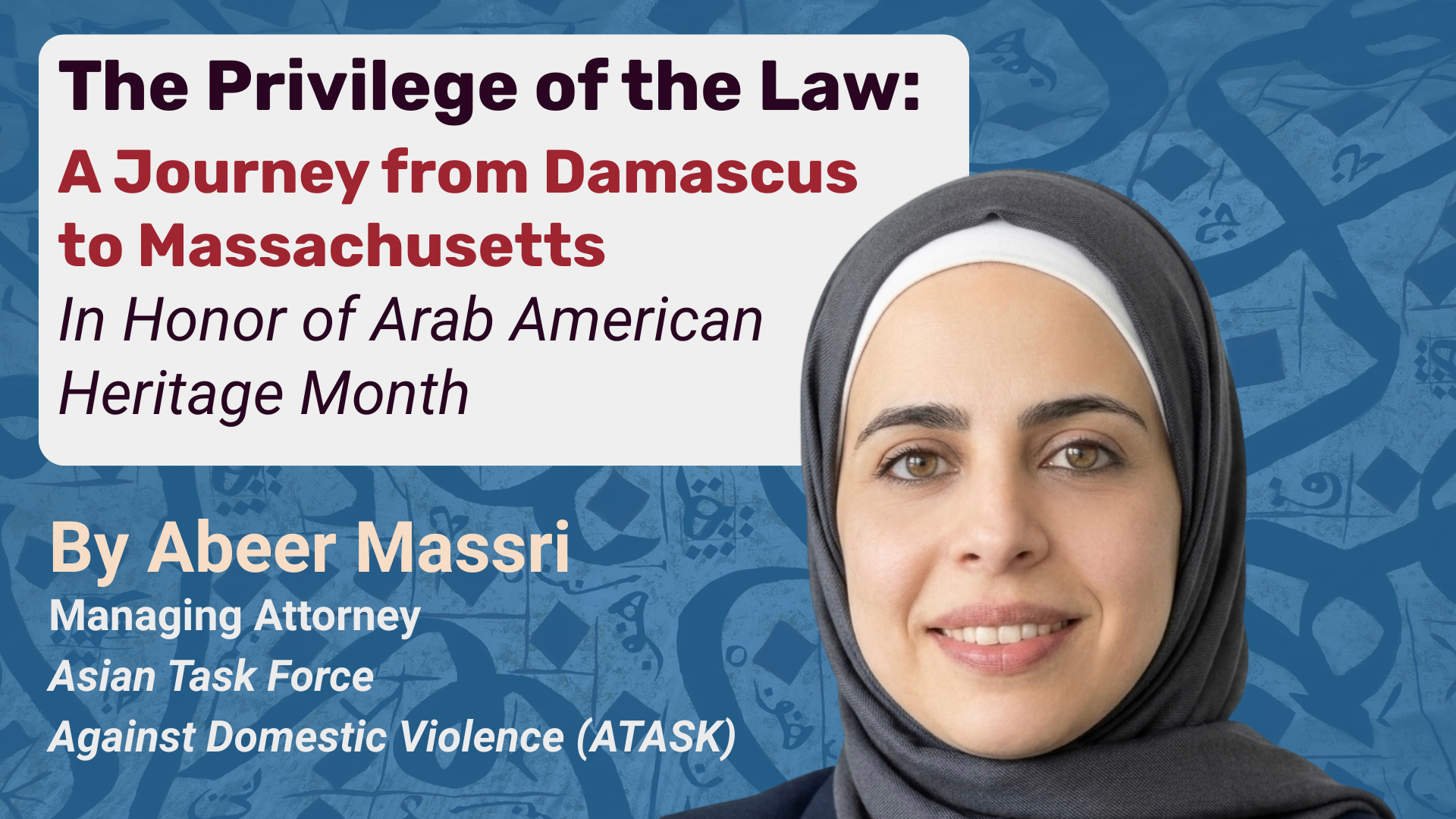
The Privilege of the Law: A Journey from Damascus to Massachusetts By Abeer Massri – Managing Attorney at MIRA Coalition memberATASK
I often wonder if those born into the American legal system can truly feel the air they breathe.
At Damascus University’s School of Law, we were taught that justice is a sacred trust. However, until late 2024, under the previous authoritarian system, enforcing equal and just laws for all was often impossible in practice. Witnessing the gap between legal principles and reality during that period made me understand that the true power of law lies in its application, not just its drafting.
When I arrived in Massachusetts over a decade ago, I was eager to find my voice again. Transitioning into the American legal profession required more than studying law – it required learning a new legal system and understanding my role within it. I had to navigate procedure, advocacy, and the practical realities of legal practice. It went beyond language or legal terminology; it was about translating lived experiences into legally cognizable claims and turning the needs of survivors into structured, enforceable legal remedies.
I have a profound respect for the legal framework of this country. Having a system that is welcoming, just, and flexible made all the difference in my journey. These laws – particularly those providing clear pathways for professional accreditation and legal status – served as the essential bridge that allowed me to translate my expertise into service for the Commonwealth.
Today, in my work as a legal aid attorney, I represent survivors of domestic violence, standing beside those who have been silenced. For me, upholding the law means more than winning a case; it means ensuring that the legal system is not manipulated by abusers to further harm victims or waste precious judicial resources.
I often find that my background serves as a vital cultural bridge for my clients. Having once been a newcomer to this system myself, I can help those who feel intimidated or silenced by authority find their footing. Every time I stand in a courtroom, I feel the weight of that sacred trust being honored – transforming the law from an abstract concept into a protective shield.
As we celebrate Arab American Heritage Month, I am reminded of what our community brings to the United States: resilience and a unique perspective. This month serves as a vital opportunity to recognize that Arab Americans are not just guests in the American story, but authors of it. We are one of many vital threads in the American fabric, bringing a perspective shaped by hard work and a deep appreciation for the stability of a fair legal system. You see this perspective in the visionary work of Steve Jobs (the son of a Syrian immigrant), the legal leadership of Judge Rosemary Barkett(the first woman Chief Justice of the Florida Supreme Court, born to Syrian parents), the scientific contributions of Dr. Farouk El-Baz (an Egyptian American who helped NASA map the moon), and the courageous medical advocacy of Dr. Mona Hanna-Attisha (an Iraqi American pediatrician who helped expose the Flint water crisis). You also see it in the quiet, daily efforts of Arab American teachers, doctors, and the dedicated clerks and social workers I work side-by-side with every day to keep the wheels of justice turning.
It is a privilege to be part of the engine that moves this country forward.
This month, I honor the Arab heritage that shaped my values by doing my part to uphold the law in a country where it is what I always hoped it could be: a source of dignity, a shield for the vulnerable, and a breath of freedom for all. We all share the responsibility to keep that air clean and that breath free for everyone.
The Asian Task Force Against domestic Violence (ATASK) is a member of the MIRA Coalition. ATASK was incorporated in 1992 to address the gaps in services for Asian domestic violence survivors in the Greater Boston and Lowell areas, including low-income immigrants with limited English language capabilities. A United Way-affiliated agency, our mission is to empower Asian survivors of domestic violence and abuse to rebuild their lives.
ATASK operates New England’s only emergency shelter, advocacy services, hotline, education programs, legal advocacy and outreach for Asian domestic violence survivors. Find out more on their website