News
- The Trump Administration’s immigration enforcement tactics continue to face headwinds in federal courts. A recent Reuters review of court records shows that federal judges have ruled over 4,400 times against the illegal detention of immigrants just since October. Last week, a federal court blocked enforcement actions at certain houses of worship, including some in Massachusetts. Yesterday, a federal judge rejected a ruling by the Board of Immigration Appeals that allowed for the indefinite detention without bond for those applying for status. Later this week, a federal judge in Minnesota will consider extending an injunction that prevents the administration from detaining refugees who have not received their green cards yet. However, more and more, courts are expressing concern with the fact that ICE is frequently ignoring such orders, with a Politico review finding that judges are growing “increasingly furious and exhausted by the Trump administration’s tactics.” Tensions are likely to increase soon; a filing in the Minnesota case included a policy memo, dated yesterday, from USCIS and ICE ordering the detention of refugees who have not adjusted status within a year despite the existing injunction issued by that court. In a separate case in Minnesota, a federal judge held a government attorney in contempt because ICE ignored a court order – the attorney will have to pay $500 for every day that ICE continues to ignore the court.
- There is little indication that the partial government shutdown, which began on Saturday, will end any time soon. Congressional negotiators were unable to come to an agreement on sensible reforms for ICE & CBP before the Friday deadline, and negotiations are now taking place between Democratic leadership in Congress and the White House. However, negotiators are keeping any details close to the chest, and advocates have little news on what issues are on the table and where negotiators are placing red lines and where they are showing a willingness to compromise. While the partial shutdown only applies to DHS, immigration functions should be largely unaffected. USCIS is mostly funded through application fees while ICE and CBP are generally considered to be essential, and their officers will continue to work without pay until funding is passed by Congress.
News
The annual state budget is the lifeline for state and local programs and services that benefit all communities—including our Commonwealth’s many immigrant communities. The Governor’s release of her proposed FY27 budget bill on January 28th signaled the official start of budget season at the Massachusetts State House. We are grateful to the Governor for her continued support for legal and other services for immigrants, and will advocate for a final budget that includes robust support for them!
MIRA Coalition is focused on two funding requests for FY27:
- $15M for Massachusetts Access to Counsel Initiative (MACI) for deportation defense. Now in its historic first year, MACI provides legal representation to low-income Massachusetts immigrants facing deportation. There is no right to legal representation in immigration court, so immigrants who cannot afford an attorney must navigate these complex proceedings alone, with little chance of success. In Massachusetts, 55% of immigrants with pending deportation cases do not have an attorney. Since its launch in November, MACI has already secured legal representation for over 250 immigrants.
- $2M for the Citizenship for New Americans Program (CNAP). U.S. citizenship is the strongest protection against deportation and family separation. In 2025, demand for citizenship services rose by 30%. CNAP funds community-based citizenship programs across the state that help green card holders apply for U.S. citizenship, offering application assistance, legal guidance, and outreach to low-income immigrants who are unable to hire a private attorney.
The House and Senate will debate and pass their own proposed budgets in April and May, respectively, and the two chambers must negotiate and pass a final budget bill by early July.
Stay tuned for updates and ways to support MIRA budget initiatives!
News
- Congress must pass funding for DHS this week or face a partial shutdown. Congress extended funding for the agency for 2 weeks to facilitate negotiations on demands for agency accountability, with that extension expiring this Friday. Following the fatal shootings in Minnesota, many Democrats in Congress have said that they will not vote to continue funding for the Department until its militaristic enforcement tactics are scaled back. Although Congressional leaders have been negotiating with the White House over continued funding, the prospects of reaching an agreement do not look promising. Democrats are calling for a number of reforms to the agencies, including stricter use-of-force policies, body cameras, an end to roving enforcement, and improved warrant procedures. While the White House has expressed a willingness to negotiate over some of these reforms, it has called others “nonstarters”.
- Leaders of ICE, CBP, and USCIS faced Congressional questions for the first time since the fatal shootings of two protestors in Minnesota last month. The DHS leaders defended the masking of their agents during enforcement operations while claiming that ICE presence at World Cup facilities this summer are necessary for safety and security. They also refused to address the recent murders by their officers by claiming they would not comment on pending investigations
- On Monday, a federal judge in Minnesota affirmed a previous Temporary Restraining Order (TRO) that blocked the continued detention of refugees in the state. The Trump Administration had used false claims of widespread fraud among refugees, especially those from Somalia, as a pretext to launch its invasion of Minnesota and began the warrantless detention of hundreds of refugees who had not yet been granted their green cards in order to reevaluate their claims. The original TRO had been issued on January 28th and was later extended to until February 25. The Trump Administration had asked the court to throw out the order or pause it pending appeal; the judge’s Monday decision was a rejection of this request.
- A federal judge in Boston blocked ICE from accessing tax-payer information from the IRS. The order, issued last Thursday, prohibits both the sharing of any additional information and also the use of any tax-payer data that the IRS has already shared with ICE due to violations of privacy protections contained in the Tax Act of 1976. Plaintiffs in the case include New Bedford-based Community Economic Development Center (CEDC). This is the second federal court to block such information sharing between ICE and the IRS; the first case will go before the appellate court in March.
- Earlier this week in California, a federal judge issued a mixed decision against two California laws passed in response to the Trump Administration’s immigration enforcement strategies. The court found that the “No Secret Police Act” discriminated against ICE officers by prohibiting them from wearing masks without including the same prohibition for state and local police. However, the court found that the “No Vigilantes Act” – which requires that non-uniformed law enforcement display IDs including name, agency, and badge number – could be enforced.
- In curious and confusing news, the Federal Aviation Administration on Wednesday suspended all flights in and around the El Paso area, extending into southeastern New Mexico. The 10 day suspension is supposedly for “special security reasons”, but the agency has provided no specifics. El Paso airport is already working to inform passengers of the 10-day shutdown.
News
These are frightening and stressful times. So today, we wanted to share something a little different — something to remind us all that we are not alone, and that we are deeply valued.
Last year at Immigrants’ Day at the State House, visitors stopped by our letter-writing station to pen messages of love and support to immigrants in Massachusetts. The letters they wrote were beautiful, heartfelt, and powerful. In honor of Valentine’s Day, MIRA staff members read 14 of those letters aloud — one for each day preceding February’s most loving holiday.
We hope these messages bring you a moment of warmth. Press play, turn up the volume, and let these words wrap around you.
And as a bonus, hear directly from Massachusetts legislators who want you to know: they stand with you.
Love isn’t just a feeling — it’s an action.
Happy Valentine’s Day. 💌

Feeling inspired? You can write your own love letter to immigrants and share on socials – graphics and hashtags provided by I Am An Immigrant’s “To Immigrants With Love” campaign
Love from our legislators:
News

Denye mizajou 5 fevriye 2026
DENYE NOUVEL POLITIK (3 fev. 2026) : TPS pou Ayiti toujou aktif
- Lèt pou Patwon yo sou Validite Pèmi Travay yo (Haitian Bridge Alliance)
Estati Protèj tanporè (TPS) pou Ayiti
Ki sa TPS pou Ayiti ye?
TPS se yon stati imigrasyon tanporè ki bay kèk Ayisyen yon pwoteksyon pou yo pa depòte yo epi ki pèmèt yo jwenn yon pèmi travay. Se pou yon maksimòm 18 mwa alafwa sèlman ou ka jwenn TPS.
Estati Pwoteje Tanporè (TPS) pou Ayiti te pwolonje ak re-deziyen apati 4 out 2024 rive 3 fevriye 2026.
Gouvènman Etazini te fè yon nouvo anons ki pwolonje ak re-deziyen TPS pou Ayisyen pou 18 mwa apati 4 out 2024 rive 3 fevriye 2026.
Kouman pou mwen reaplike? Si w gen yon aplikasyon TPS ayisyen ki annatant oswa I-765 ki gen rapò ak TPS apati 1ye jiyè 2024:
Ou pa bezwen re-aplike; otomatikman ou ap konsidere pou nouvo deziyasyon. Si yo apwouve w, yo ap ba w TPS ak EAD jiska fevriye 2026.
Si ou genyen kounye a Estati Pwoteksyon Tanporè (TPS) ak yon Dokiman Otorizasyon Travay (EAD), ou dwe re-enskri ant 1ye Jiyè 2024 jiska 30 Out 2024 pou asire ou kenbe TPS ou ak otorizasyon travay ou.
Sèlman bay yon avoka oswa yon ajans sèvis legal lajan pou renouvle TPS ou!
Ki pri pou aplike?
Pri pou aplike epi soumèt fòm TPS lan enkli:
● Yon frè $30 pou yon tès anprent dijital byometrik.
● Pou soumèt Fòm I-821, li koute $0 pou renouvle, ak $50 si sa a se premye aplikasyon w lan.
● Pou soumèt Fòm I-765, li koute $470 si ou ranpli sou Entènèt, oswa $520 si ou voye fòm
papye.
Èske mwen kalifye pou aplike gratis?
Ou ka kalifye pou yon egzansyon frè si oumenm, mari oswa madanm ou, oswa timoun yo ap viv nan
yon abri oswa k ap resevwa yon benefis piblik tankou Pwogram Asistans Nitrisyon Siplemantè
(SNAP), Èd Tranzisyon pou Fanmi ak Timoun Depandan (TAFDC), oswa kouvèti MassHealth. Si yo
apwouve, USCIS ap anile tout frè ki asosye ak aplikasyon w lan.
Pou w ka resevwa yon dispans frè a, ou dwe ranpli Fòm I-912 epi bay prèv ke ou ap resevwa yon
benefis piblik lè w bay yon resi benefis oswa bay youn nan dokiman sa yo:
● Lèt MassHealth
● Lèt Verifikasyon Depatman Asistans Tranzisyon(DTA)
● Lèt abri
Èske mwen ka aplike pou TPS si mwen gen liberasyon kondisyonèl oswa si mwen aplike pou azil?
Kouman pou mwen aplike pou premye fwa?
Ou ka ranpli yon premye aplikasyon ant 1ye jiyè 2024 rive 3 fevriye 2026.
Pou kalifye, ou dwe pwouve tou de sa ki annapre yo:
● Ou rete kontinyèlman Ozetazini depi 3 jen 2024.
● Ou te toujou gen prezans fizik Ozetazini depi 4 Out 2024.
Y ap mande w pou pwouve idantite w ak nasyonalite w ak youn nan bagay sa yo:
❏ Paspò (ekspire se ok); OSWA
❏ Batistè ak tradiksyon sètifye; OSWA
❏ Dokiman idantite nasyonal ak foto w ak/oswa anprent ou
Y ap mande w pou pwouve idantite w ak nasyonalite w ak youn nan bagay sa yo:
❏ Paspò (ekspire se ok); OSWA
❏ Batistè ak tradiksyon sètifye; OSWA
❏ Dokiman idantite nasyonal ak foto w ak/oswa anprent ou
Ou ka itilize youn nan dokiman sa yo pou pwouve ou abite Ozetazini:
❏ Dosye travay; souch peman, dosye taks sou revni;
❏ Dosye lekòl la;
❏ resi lwaye; peman ipotèk; bòdwo sèvis piblik;
❏ Lopital oswa dosye medikal;
❏ Dosye finansye: Deklarasyon labank; Deklarasyon taks
❏ Atestasyon òganizasyon relijye, sendika, òganizasyon;
❏ Batistè timoun ki fèt Ozetazini;
❏ Politik asirans; anrejistreman machin
❏ Nenpòt lòt dokiman ki pral ede pwouve ke ou te prezan Ozetazini
Ki kote mwen jwenn sipò?
Ajans sèvis legal lokal yo ak òganizasyon kominotè yo pral ofri èd gratis oswa a bon mache pou aplike pou TPS. Okouran de magouyè yo, pa bay okenn moun ki pwomèt pou renouvle aplikasyon TPS ou a lajan. Olye de sa, chèche èd nan men ajans sèvis legal serye ak òganizasyon kominotè yo.
Telechaje dokiman enfòmatif la isit la pou aprann plis.
✨ Resous Adisyonél ✨
News
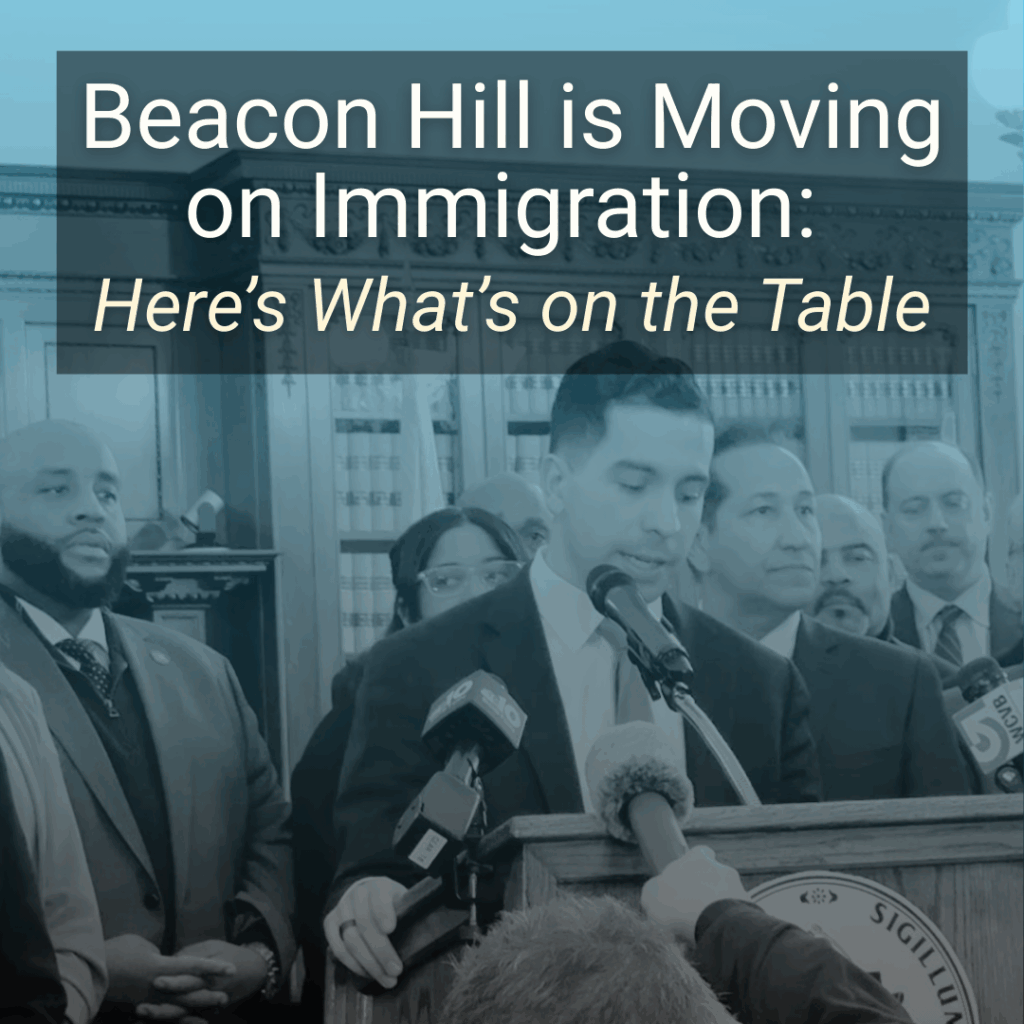
It is a pivotal moment on Beacon Hill. After months of increasingly aggressive federal immigration enforcement, Massachusetts policymakers last week launched a flurry of new immigration bills and policy proposals. These proposals aim to strengthen due process, improve oversight, and protect residents from federal overreach.
Two proposals are especially notable. Not only are they significant in their own right, but they also add important momentum and scope to the many immigration bills already pending before the Massachusetts State Legislature.
This moment did not happen by accident. It reflects the sustained pressure and persistent advocacy of community-based organizations, faith leaders, legal advocates, and everyday residents who have demanded urgent action for years.
The PROTECT Act (H.D. 5608) — A Broad Legislative Package
Last week, the Massachusetts Black and Latino Legislative Caucus (BLLC) unveiled the PROTECT Act (HD. 5608). Introduced by BLLC Chair Rep. Andy Vargas of Haverhill and Rep. Judith Garcia of Chelsea, it represents a year-long effort to build consensus around a set of immigration proposals derived from bills introduced earlier this session.
At its core, the PROTECT Act is designed to strengthen due process and reduce harmful entanglement between Massachusetts systems and federal civil immigration enforcement. It focuses on several key areas.
First, it would create important protections for immigrants detained in federal immigration custody at the Plymouth House of Correction. It would ensure people receive clear information about their rights in their primary language and access to legal services. Importantly, it would require the facility to maintain a secure locator system, so families and attorneys can confirm the whereabouts of detainees, and require notice of any transfers within 6 hours.
Second, it would largely prohibit any new 287(g) agreements, with narrow exceptions for enforcing criminal laws, subject to strict oversight and high procedural barriers. These agreements deputize local law enforcement to carry out federal civil immigration enforcement. This is especially important given concerns that such agreements undermine trust between communities and police.
Third, it would prohibit civil immigration arrests in and around, and to and from, courthouses,major loci of immigration arrests. The goal is to ensure victims, witnesses, and defendants can safely access the justice system. No one should have to fear being targeted by ICE for simply participating in court proceedings.
Finally, it includes reforms to make it easier and faster for survivors of serious harm to access immigration protections and benefits. This includes survivors of workplace exploitation and trafficking. The bill would help individuals secure the documentation needed to apply for protections through U and T visas.
Governor Healey’s Executive Order and Proposed Legislation
In parallel with legislative efforts, Governor Maura Healey introduced a package of executive and legislative actions. These are intended to protect Massachusetts residents from abuses by U.S. Immigration and Customs Enforcement (ICE). They focus especially on the places people depend on most.
The Governor’s proposed legislation would limit immigration enforcement activity in sensitive locations. This includes schools, hospitals, places of worship, and courthouses. These actions reflect a simple principle: no one should have to choose between safety and everyday life. That includes getting medical care, sending a child to school, practicing one’s faith, or seeking justice.
The executive order tightens restrictions on new 287(g) agreements with ICE. It bars state agencies from entering into new agreements unless they receive written approval and can demonstrate a “specific, articulable public safety risk or need.”It also addresses whether state resources, personnel, or facilities can be used to support civil immigration enforcement. To learn more about which facilities are covered, please refer to Massachusetts Law Reform Institute’s guidance here. The Governor’s proposal reinforces the idea that state government should not be complicit in practices that destabilize communities. It also aims to protect trust between residents and public institutions.
Why This Matters and What Comes Next
The stakes are high. Across Massachusetts, immigrants are sheltering in place, relying on community support to provide for their basic needs or to accompany their children to and from school. Immigrant businesses are shuttered. Families are separated, children are traumatized, workplaces lose employees overnight, and entire communities withdraw from public life.
These proposals are an important step toward long-overdue protections for immigrant communities in Massachusetts. The question now is whether the Legislature will match this moment with urgency and follow-through.
Stay tuned for updates and opportunities to engage as these bills move through the legislative process!
News
- In a very welcome bit of good news, a federal judge in Washington, D.C. issued a last minute reprieve to Haitians legally in the US under Temporary Protected Status (TPS). Despite having issued a travel advisory in July due to “kidnapping, crime, terrorist activity, civil unrest, and limited health care,” the Trump Administration determined in November that the situation in Haiti was stable enough to end TPS for the nation and send over 350,000 Haitians back to the nation. TPS was slated to end on Tuesday, but the federal court found that the administration had failed to follow legally required processes for the termination of status and further suspects that, “the Secretary has engaged in a pattern and practice of terminating all TPS designations without the country specific statutorily-mandated periodic review.” This temporary stay by the court means that Haitians with TPS maintain their legal status in the US as well as their work authorization. For additional information and community resources, please visit MIRA’s TPS for Haiti page.
- Following the mass unrest and violence caused by the administration’s militaristic enforcement of civil immigration laws in Minnesota, US border czar Tom Homan announced that 700 federal agents will leave the state. Although this would appear to be an effort to deescalate, Homan did not provide any timeline for when the agents would depart, and the move would still leave 2,300 DHS officers roaming the streets. DHS Secretary Kristi Noem has said that all agents in Minneapolis would be issued with body cameras, and that body cameras would be issued to all officers across the country as funding becomes available. Meanwhile, ICE operations in Minneapolis have become less obvious, but school leaders have described harassment by DHS officials, and activists continue to be arrested on trumped up charges of interfering with law enforcement.
- The violence and unrest in Minnesota has finally motivated some members of Congress to push back against the inhumane enforcement practices. Congressional leadership had been trying to push through a funding package last week, which including funding for DHS, before a Friday deadline. However, calls for increased accountability by DHS stalled the package leading to a brief partial government shutdown over the weekend. Negotiators eventually agreed on and passed a package which only funds DHS for 2 weeks, ending on February 13. On Wednesday, Democratic leadership laid out their list of reforms, which includes an end of masking of DHS agents, an end to indiscriminate arrests, protections for sensitive locations, and an end to racial profiling. While these might seem like commonsense reforms, there is little hope that the two sides will reach agreement before the deadline.
- Following increasing concerns of widespread civil rights abuses, two courts in Oregon have issued rulings this week trying to reign in DHS tactics. The first ruling, issued on Tuesday, prohibits the use of tear gas or “nonlethal” munitions against protesters at the ICE building in Portland. While this temporary measure is welcome by those exercising their free speech rights, a similar ruling last month in Minnesota was quickly blocked by an appellate court. The second ruling this week prohibits the agency from making warrantless arrests unless there is a likelihood of escape. Courts in Colorado and Washington, D.C. have already issued similar rulings, which the administration has appealed.
- Last week, District Attorneys from across the country announced the formation of the Fight Against Federal Overreach (FAFO), a coalition intended to hold federal officials accountable for exceeding their lawful authority. The coalition formed due to concerns over “warrantless entries, unlawful detentions, and coercive enforcement tactics by federal agents” and will work to share best practices and strategies as well coordinate their efforts to combat civil liberties abuses by the Trump Administration.
News
How to be an Immigrant Advocate
News
Last updated February 3, 2026
POLICY UPDATE (Feb. 3, 2026) : TPS for Haiti Remains Active
- Letter for Employers on Validity of Work Permits (Haitian Bridge Alliance)
Li enfòmasyon sa yo an kreyòl ayisyen.
Temporary Protected Status (TPS) for Haiti
What is TPS for Haiti?
TPS is a temporary immigration status that gives some Haitians protection from deportation and the ability to get a work permit. You can only receive TPS for up to 18 months at a time.
Who can apply for TPS?
If you are Haitian and you have been living in the United States since at least November 6, 2022, you are currently eligible for TPS. There has been a new update that now allows eligible Haitian nationals who have continuously lived in the United States since June 3, 2024, to file applications for TPS.
Temporary Protected Status (TPS) for Haiti has been Extended and Redesignated from August 4, 2024 to February 3, 2026.
A new announcement made by the United States government, has extended and redesignated TPS for Haitians for 18 months from August 4, 2024 to February 3, 2026.
How do I reapply? If you have a pending Haitian TPS applications or TPS-related I-765s as of July 1st, 2024:
- You do not need to reapply; you will be automatically considered for new designation.
- If approved, you will be granted TPS and EAD through February 2026.
How do I reapply? For current TPS beneficiaries who EAD expires August 3, 2024:
- If you currently have TPS for Haiti, you must re-register during the 60-day re-registration period from July 1, 2024 through August 30, 2024, to ensure they keep your TPS and employment authorization. To file an initial or renewal application for TPS, you will need to submit Form I-821 and Form I-765, along with evidence of their eligibility.
How do I apply for the first time?
- You can file an initial application between July 1, 2024 to February 3, 2026.
To qualify, you must prove both of the following:
- You have continuously resided in United States since June 3, 2024.
AND
- You have continuously had physical presence in the United States since August 4, 2024.
What is the Cost to Apply?
The cost to apply and submit TPS forms include:
- A $30 fee for a Biometrics digital fingerprinting test.
- To submit Form I-821, it costs $0 to renewal, and $50 if this is your initial application.
- To submit Form I-765, it costs $470 if you filed online, or $520 if you file on paper.
Do I Qualify for a Fee Waiver?
You may qualify for a fee waiver if you are living in a shelter or receiving a public benefit such as Supplemental Nutrition Assistance Program (SNAP), Transitional Aid to Families with Dependent Children (TAFDC), or MassHealth coverage.
In order to receive a waiver of the fee, you must file Form I-912 and provide proof that you are receiving a public benefit. If approved, USCIS will waive all fees associated with your application.
How do I apply for the first time?
- You can file an initial application between July 1, 2024 to February 3, 2026.
To qualify, you must prove both of the following:
- You have continuously resided in United States since June 3, 2024.
AND
- You have continuously had physical presence in the United States since August 4, 2024.
You will be asked to prove your identity and nationality with one of the following:
- Passport (expired is ok); OR
- Birth certificate and certified translation; OR
- National identity document with your photo and/or fingerprint
You will be asked to prove your date of entry into the United States with at least one:
- I-94
- Passport stamp
- Stamp in other arrival paperwork
The following documents can be used to prove you have resided in the United States:
- Employment records; pay stubs, income tax records;
- School records;
- Rent receipts; mortgage payments; utility bills;
- Hospital or medical records;
- Financial records: Bank statements; Tax returns
- Attestations from religious organizations, unions, organizations;
- Birth certificates of children born in the U.S.;
- Insurance policies; vehicle registration
- Any other documents that will help prove that you have been present in the U.S
Local legal service agencies and community-based organizations will be offering free or low-cost help applying for TPS. Be aware of scammers, do not give money to anyone who promises to renew your TPS application. Instead seek help from reliable legal service agencies and community-based organizations. Visit www.masslrf.org to find your local legal services agency.
How do I stay updated?
The US government announces TPS for Haiti information on the government’s website here: www.uscis.gov/tps. MIRA Coalition also puts that information on our website www.miracoalition.org and social media, including Instagram @mira_coalition and Facebook @miracoalition.
Download the factsheet for more info about TPS for Haiti
TPS for Haiti: Do I Qualify? (6.28.2024)
Asylum & Temporary Protected Status: Should I Apply for One or Both? (8.9.2024)
✨ Additional Resources✨
News
TPS for Haiti Remains Active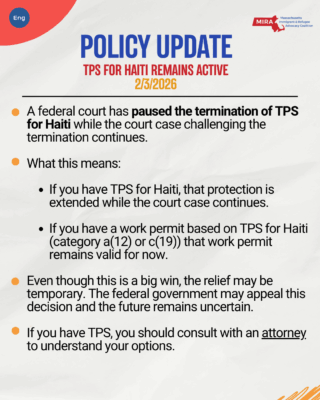
A federal court has paused the termination of TPS for Haiti while the court case challenging the termination continues.
What this means:
- If you have TPS for Haiti, that protection is extended while the court case continues.
- If you have a work permit based on TPS for Haiti (category a(12) or c(19)) that work permit remains valid for now.
Even though this is a big win, the relief may be temporary. The federal government may appeal this decision and the future remains uncertain.
If you have TPS, you should consult with an attorney to understand your options.
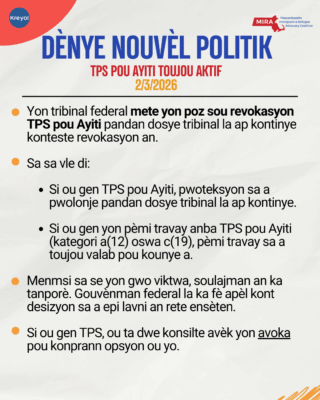 TPS pou Ayiti toujou aktif
Yon tribinal federal mete yon poz sou revokasyon TPS pou Ayiti pandan dosye tribinal la ap kontinye konteste revokasyon an.
Sa sa vle di:
- Si ou gen TPS pou Ayiti, pwoteksyon sa a pwolonje pandan dosye tribinal la ap kontinye.
- Si ou gen yon pèmi travay anba TPS pou Ayiti (kategori a(12) oswa c(19), pèmi travay sa a toujou valab pou kounye a.
Menmsi sa se yon gwo viktwa, soulajman an ka tanporè. Gouvènman federal la ka fè apèl kont desizyon sa a epi lavni an rete ensèten.
Si ou gen TPS, ou ta dwe konsilte avèk yon avoka pou konprann opsyon ou yo.